7 Problems in the NEMT Industry and How to Avoid Them
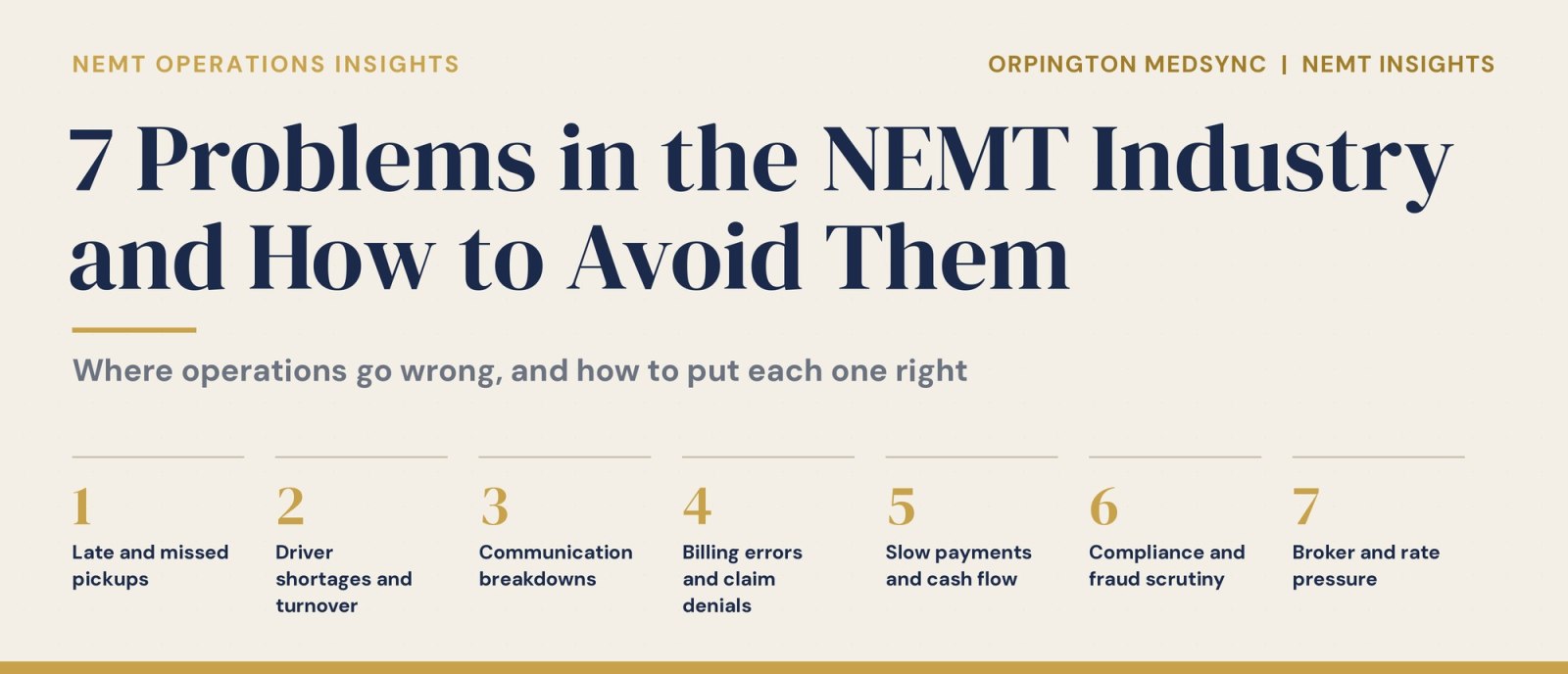
Most problems in non-emergency medical transportation are visible long before they cost a trip, a claim or a contract. The operators that avoid them look early, document everything and staff the back office for the work.
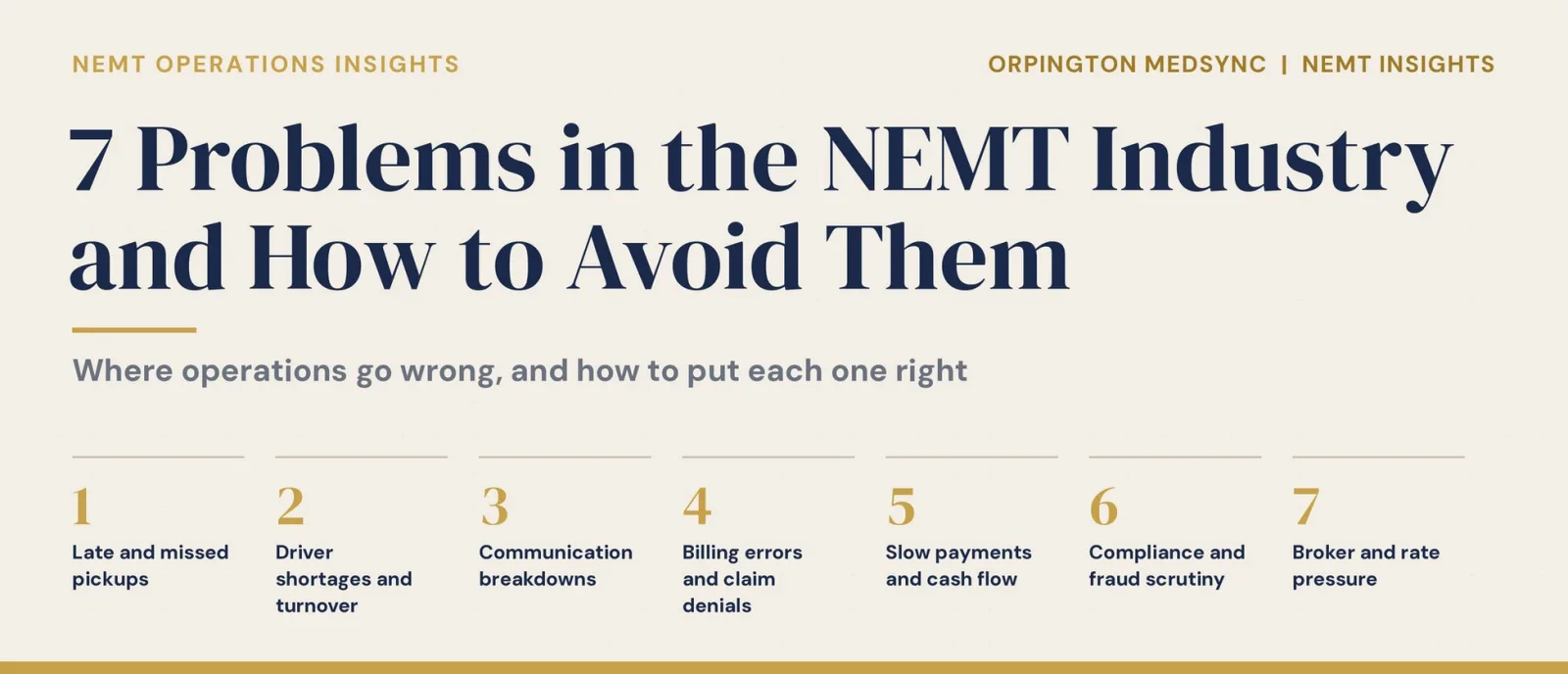
7 Problems in the NEMT Industry and How to
Avoid Them
Avoid Them
Most problems in non-emergency medical transportation are visible long before
they cost a trip, a claim or a contract. The operators that avoid them look early,
document everything and staff the back office for the work.
In short:
Non-emergency medical transportation is growing, but most of its costly problems
they cost a trip, a claim or a contract. The operators that avoid them look early,
document everything and staff the back office for the work.
are visible before they cost a trip, a claim or a contract. Seven problems account for most
of them: late and missed pickups, driver turnover and communication breakdowns in the
service; unclean claims and aging receivables in the money; and documentation gaps and
broker changes in compliance and the market. Each can be avoided with early, deliberate
work.
Non-emergency medical transportation (NEMT) is growing. One industry outlook estimates
a compound annual growth rate of 9 percent between 2026 and 2032
[1]
, and research
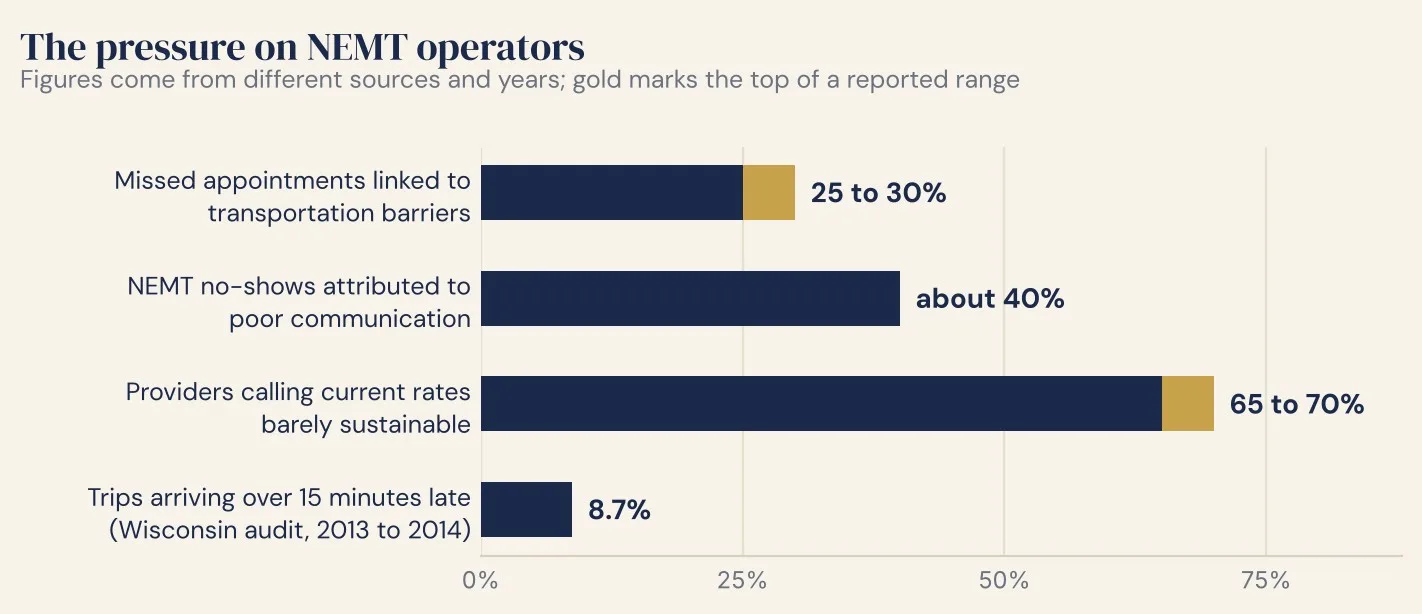
summarized by NEMT Platform attributes 25 to 30 percent of missed medical
appointments to transportation barriers
[2]
. A ride that fails to arrive therefore costs more
than the trip itself, and payers, brokers and regulators measure operators accordingly.
of them: late and missed pickups, driver turnover and communication breakdowns in the
service; unclean claims and aging receivables in the money; and documentation gaps and
broker changes in compliance and the market. Each can be avoided with early, deliberate
work.
The pressure is not only about demand. The 2026 NEMTAC Rate and Cost Survey, as reported by RouteGenie, found 65 to 70 percent of providers calling current rates barely
sustainable
[1]
, which leaves little room for avoidable mistakes (Figure 1). The seven
problems below are the ones that most often turn a sound operation into a struggling one,
grouped by where they arise: in the service, in the money and in the compliance and market
environment.
Key takeaways
The stakes.
Transportation barriers are linked to 25 to 30 percent of missed medical
appointments, and 65 to 70 percent of providers call current rates barely sustainable.
The pattern.
The seven problems fall into three groups: the service, the money and the
compliance and market environment.
© Orpington MedSync
www.orpingtonmedsync.com
Page
1
of
6
grouped by where they arise: in the service, in the money and in the compliance and market
environment.
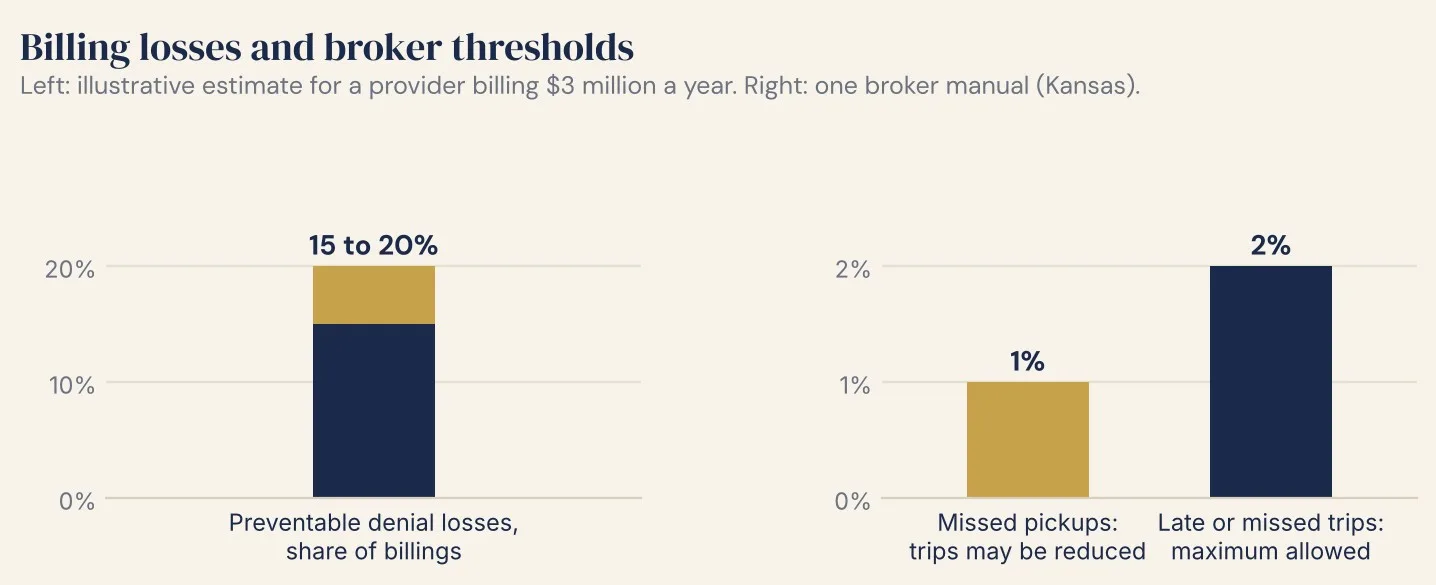
Modivcare’s manual for Kansas, as summarized by Hibambi, caps late or missed trips at 2
percent of assigned trips and warns that providers above 1 percent missed pickups risk
having trips reduced
[5]
.
How to avoid it:
confirm rides ahead of time, schedule with
percent of assigned trips and warns that providers above 1 percent missed pickups risk
realistic buffers, watch live trip status rather than waiting for a phone call, and keep
experienced dispatchers on duty whenever trips are running.
Problem 2: Treating driver turnover as only a hiring problem
NEMT providers often struggle to hire and retain qualified drivers, and a shortage affects
service quality and reliability
[7]
. The effect compounds, because in an industry already
facing driver shortages, avoidable no-shows make retention even harder
[6]
.
How to avoid
it:
keep the work predictable with fair, efficient schedules, pay promptly, and let dispatch,
experienced dispatchers on duty whenever trips are running.
support and billing staff handle the paperwork and phone calls so drivers can focus on driving.
Problem 3: Leaving communication to chance
A NEMT trip involves patients, caregivers, medical facilities, brokers, dispatchers and drivers,
and a breakdown at any point in that chain can cause a missed trip
[6]
. NEMT Platform calls
poor communication the most common cause of no-shows, accounting for approximately
40 percent of missed appointments
[2]
.
How to avoid it:
confirm every hand-off, contact
riders before the trip, give facilities a real person to call, and make sure drivers and
dispatchers work from the same up-to-date information.
© Orpington MedSync
www.orpingtonmedsync.com
Page
2
of
6
dispatchers work from the same up-to-date information.
NEMT trips are billed to several brokers and payers, each with its own rules. Missing trip logs, inaccurate billing codes and a lack of proof of service are common documentation
errors that lead to denials
[10]
. Medicaid requires proof that the ride occurred exactly as
billed, including pickup and drop-off timestamps, and a single missing detail can trigger
denials or even fraud investigations
[8]
. Mindbowser estimates that for a provider billing $3
million a year, denials tied to missed eligibility checks or skipped prior authorizations can
cost $450,000 to $600,000 annually
[9]
. That is a vendor estimate rather than an audit
finding, but it shows the scale of what is at stake.
How to avoid it:
verify eligibility at
scheduling, capture complete trip data every time, submit on a steady cadence, and trace every denial to its root cause (Table 1).
Table 1. Four checks that keep an NEMT claim clean
Check
What to confirm
Why it matters
Eligibility
The member is eligible for NEMT at the time of
scheduling.
Missed eligibility checks drive
denials
[9]
.
Trip record
Pickup and drop-off times, locations and
every other required field.
Medicaid requires proof the ride
occurred as billed
[8]
.
Codes and
rates
rates
The correct code and rate for each payer and
trip type.
Inaccurate billing codes lead to
denials
[10]
.
Follow-up
Each denial traced to its cause and corrected
at the source.
Delayed payments strain cash flow
[10]
.
Problem 5: Letting receivables age
Payment delays occur when claims are denied or need extensive follow-up, and they strain
cash flow and hinder operations
[10]
. Fuel, insurance, maintenance and payroll do not wait
for reimbursement.
How to avoid it:
review receivables weekly, follow up on aging claims
trip type.
promptly, reconcile payments against what was billed, and appeal underpayments, so that
revenue already earned is actually collected.
Figure 2.
Billing losses and broker thresholds. Left: the 15 to 20 percent range is calculated from Mindbowser’s
illustrative $450,000 to $600,000 loss for a provider billing $3 million a year
[9]
. Right: thresholds in Modivcare’s
Kansas manual, as summarized by Hibambi
[5]
. Thresholds vary by broker and state.
© Orpington MedSync
www.orpingtonmedsync.com
Page
3
of
6
revenue already earned is actually collected.
Orpington MedSync | NEMT Operations Insights
3. Compliance and market pitfalls: scrutiny and shifting brokers
Problem 6: Treating documentation as an afterthought
NEMT faces heightened scrutiny from Medicaid fraud investigators because of historically
high rates of billing irregularities, and even unintentional billing errors can trigger
investigations that lead to payment denials, contract termination or penalties
[12]
. The
high rates of billing irregularities, and even unintentional billing errors can trigger
Government Accountability Office identified provider and vehicle screening, trip logs, GPS data and claims review as tools states use to detect NEMT fraud, and each depends on
documentation an operator either has or does not have
[11]
. Some states add their own trip
verification rules, such as New York’s GPS breadcrumb mandate that took effect in April
2023
[9]
.
How to avoid it:
keep driver credentials, background checks, vehicle inspections
and training records current and easy to produce, capture complete trip data every time, and protect patient information with proper HIPAA controls.
Problem 7: Being caught out by broker changes and thin margins
Broker relationships change often. In 2026 Georgia consolidated all five Medicaid NEMT regions under Verida, and Colorado enacted a 2 percent provider rate reduction in July,
effective the same day as its metro broker cutover
[11]
. When a broker changes, rates, billing
rules, claim submission windows, payment cycles and documentation requirements can
change with it
[11]
. The 2026 NEMTAC survey also found about 60 percent of respondents
expecting rural providers to exit if nothing changes
[1]
.
How to avoid it:
watch state
procurement notices and broker bulletins, keep workflows flexible enough to adapt, and use your own trip and payer data to see which routes and contracts actually earn their place.
Table 2. The seven NEMT problems at a glance
Problem
Early warning sign
How to avoid it
1. Late and missed
pickups
pickups
Complaints rising, no live view of
trips
Confirm rides; monitor trips live
2. Driver turnover
Repeated gaps in coverage
Predictable schedules, prompt pay
3. Communication
Riders and clinics unsure whom to
call
Confirm every hand-off
4. Unclean claims
Denials with no root-cause review
Verify eligibility; complete trip data
5. Aging receivables
No weekly receivables review
Weekly review and follow-up
6. Documentation gaps
Records slow to produce on request
Audit-ready credentials and trip
data
trips
7. Broker and rate
changes
Broker bulletins go unread
Watch notices; use payer data
4. Your first 90 days of tightening an NEMT operation
changes
Knowing the problems is useful only if it changes what happens on Monday morning. A
sound plan starts with 90 days of fact-finding, and none of the steps below needs a new contract or a new system.
Days 1 to 30: establish the facts
sound plan starts with 90 days of fact-finding, and none of the steps below needs a new contract or a new system.
Pull late and missed trip rates by broker, the reasons behind recent denials, the age of every open receivable and a list of documentation gaps. Name one owner each for dispatch,
customer support, billing, receivables and compliance, so every number has a person behind it.
© Orpington MedSync
www.orpingtonmedsync.com
Page
4
of
6
customer support, billing, receivables and compliance, so every number has a person behind it.
Orpington MedSync | NEMT Operations Insights
Days 31 to 60: clean and decide
Fix how complete trip data is captured, start a weekly receivables review and confirm that
driver and vehicle records can be produced on request
[12]
. Decide which functions stay in-
house and which a specialist partner could run, and compare what each option costs.
Days 61 to 90: commit with evidence
Set performance targets against the thresholds your brokers actually apply
[5]
, plan for the
next broker or rate change
[11]
, and agree how progress will be reported to leadership in
plain language. Two habits keep the 90 days honest. Every assumption gets an owner and a date by which it will be proven or dropped, and someone independent reviews the performance numbers before they are shared.
5. How Orpington MedSync supports your NEMT operation
An extension of your team.
Orpington MedSync runs dispatch, customer support, billing,
accounts receivable and full-cycle medical billing as an extension of the operator’s own
team, held to service levels and measured weekly
[13]
.
Dispatch that keeps trips on time.
Dispatch is backed by service levels and live
performance dashboards, so a slipping pickup is seen while it can still be saved
[13]
.
Billing that knows the brokers.
The team handles broker billing across MAS, Modivcare,
MTM and more, along with medical billing and revenue cycle management for U.S. providers
using ICD-10, CPT and HCPCS coding
[13]
.
Always on, audit-ready.
HIPAA-trained agents are available 24/7, with audit-ready
processes and end-to-end PHI controls
[13]
.
Insight from your own data.
Orpington MedSync makes recommendations based on
mobility data so operators can reduce cost and grow trips, and it states that its model can
run up to 50 percent lower in cost than building the same team in-house
[13]
.
For an operator deciding where to start, the sensible first step is a conversation. Orpington MedSync offers a free 30-minute consultation to show where the wins are hiding in a
current operation
[13]
.
6. Frequently asked questions about NEMT operations
What are the most common problems NEMT providers face?
Late and missed pickups, driver shortages, communication breakdowns, billing errors and claim denials, slow payments, compliance and fraud scrutiny, and shifting broker and rate
conditions. Table 2 summarizes the early warning sign and the fix for each.
How much do late or missed trips matter to brokers?
conditions. Table 2 summarizes the early warning sign and the fix for each.
One broker manual, Modivcare’s for Kansas, caps late or missed trips at 2 percent of assigned trips and warns that providers above 1 percent missed pickups risk having trips
reduced
[5]
. Thresholds vary by broker and state, so check each contract.
Why do NEMT claims get denied?
Common causes include missed eligibility checks or skipped prior authorizations
[9]
,
incomplete trip records
[8]
, and documentation errors such as missing trip logs or
inaccurate billing codes
[10]
.
© Orpington MedSync
www.orpingtonmedsync.com
Page
5
of
6
Orpington MedSync | NEMT Operations Insights
How is NEMT fraud detected?
The Government Accountability Office identified provider and vehicle screening, trip logs,
GPS data and claims review as the tools states use
[11]
. Complete, consistent
documentation is the best protection for an honest operator.
What should an NEMT operator do first?
Review late and missed trip rates, denial reasons, receivables and documentation, as set out
in the 90-day plan above. For an outside view, Orpington MedSync offers a free 30-minute
consultation
[13]
.
Sources & Further Reading
[1] RouteGenie – “NEMT Industry Trends: What’s Changing in 2026 and Beyond”
[2] NEMT Platform – “Reduce No-Shows and Cancellations with Smart NEMT Scheduling Tools,” June 2025
[3] Tobi Cloud – “5 Challenges of Non-Emergency Medical Transportation and Tips on Overcoming Them”
[4] Wisconsin Legislative Audit Bureau – “Non-Emergency Medical Transportation,” Report 15-4 highlights
[5] Hibambi – “Ultimate Guide to NEMT KPIs”
[6] NEMT Platform – “Addressing the No-Show Problem in NEMT: Best Practices and Software Solutions,”
December 2025
[7] NEMT Platform – “Overcoming Common Challenges in the NEMT Industry: Strategies for Success”
[8] Mindbowser – “Medicaid NEMT Billing Challenges (and How to Overcome Them)”
[9] Mindbowser – “NEMT Dispatch Problems (and How to Fix Them)”
[10] Spedsta – “The Challenges of Billing in the NEMT Industry”
[11] RouteGenie – “NEMT Broker Landscape Is Changing: How to Stay Compliant with Everyone”
[12] Expert Law Firm – “Top 5 Legal Risks NEMT Providers Face (And How to Avoid Them)”
[13] Orpington MedSync – “Healthcare Back-Office Partner” (company website)
© Orpington MedSync
www.orpingtonmedsync.com
Page
6
of
6
in the 90-day plan above. For an outside view, Orpington MedSync offers a free 30-minute