NEMT Best Practices: 8 Habits of a Reliable, Compliant and Profitable Business
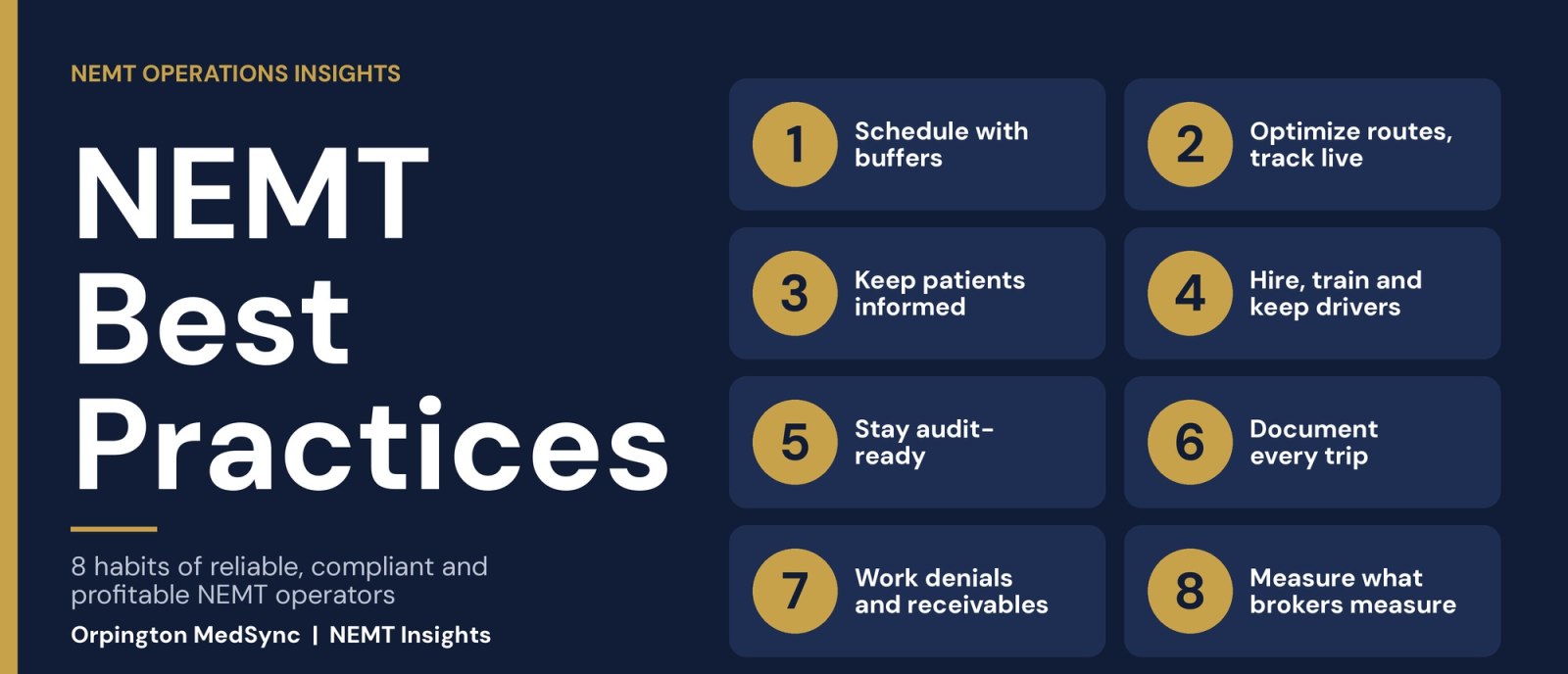
Non-emergency medical transportation (NEMT) brokers score providers on on-time performance, cancellation ratios, call-center responsiveness, compliance training and cost per trip, so the way an operator runs each day decides whether volume grows. There is no single national standard for these metrics, which makes documented, repeatable habits the safest way to perform well with every broker.
Orpington MedSync | NEMT Operations Insights
NEMT OPERATIONS INSIGHTS
NEMT Best Practices: 8 Habits of a
Reliable, Compliant and Profitable
Business
Non-emergency medical transportation (NEMT) is the scheduled, non-urgent
transport of patients to medical care. The operators that brokers keep and patients trust share eight habits, from buffered scheduling and live dispatch to audit-ready
records and weekly receivables reviews. This guide shows how to build each one.
NEMT OPERATIONS INSIGHTS
NEMT
Best
Practices
8 habits of reliable, compliant and
profitable NEMT operators
Orpington MedSync
|
NEMT Insights
Schedule with buffers
Optimize routes,
track live
Keep patients
informed
Hire, train and keep
drivers
Stay audit-ready
Document every trip
Work denials and
receivables
Measure what
brokers measure
In short:
A best practice in NEMT is a repeatable habit that protects three things at once:
on-time service, compliance and cash flow. Build the schedule with buffers, track every trip live, keep patients informed, hire and keep screened drivers, stay audit-ready, document
every trip for billing, work denials and receivables every week, and measure the numbers
your brokers measure.
NEMT moves patients to scheduled care such as dialysis, therapy and primary care visits,
usually under contracts with Medicaid brokers and health plans. Brokers decide which
providers receive more trips based on a scorecard that includes on-time performance,
cancellation ratios, call-center responsiveness, compliance training and cost per trip
[16]
.
That means the way you run the business, day after day, decides whether your volume
grows or shrinks.
There is also no single national standard for NEMT metrics. Ask ten providers how they
define on-time performance and you will get ten answers, and what satisfies one broker can
fall short with another
[4]
.
Please note that
many of the performance figures in this guide
come from software vendors and state programs, so they are examples of what is
achievable, not guarantees. The sections below explain each practice, how to apply it and
why it matters, and Section 8 turns them into a 90-day plan.
Key takeaways
Run the service on time.
Buffers, live routing and proactive messages prevent most late
and missed trips (Sections 2.01 to 2.03).
© Orpington MedSync
www.orpingtonmedsync.com
Page
1
of
7
1
2
3
4
5
6
7
8
Orpington MedSync | NEMT Operations Insights
Build the team.
Screen, train and retain drivers, because turnover is one of the largest
hidden costs in the business (Sections 3.01 to 3.03).
Stay audit-ready.
Keep driver, vehicle, privacy and trip records in one place and self-audit
every quarter (Sections 4.01 and 4.02).
Protect cash flow.
Document the trip at the point of service, verify eligibility before
dispatch and work denials weekly (Sections 5.01 and 5.02).
Measure like a broker.
Track seven KPIs and report the same numbers your brokers see
(Sections 6.01 and 6.02).
1. What NEMT best practices are, and why they pay
In NEMT, a best practice is a documented, repeatable way of doing a task that reduces late
trips, compliance gaps or denied claims. It is different from a one-time fix because it is owned by a named person, measured on a schedule and reviewed when the numbers move.
The practices in this guide fall into four groups: the service, the people, compliance and the money.
The case for investing in them is practical. In one vendor-reported example, automated
alerts and schedule adjustments lifted on-time pickups from 84 percent to 94 percent
[1]
.
In another, GPS route optimization raised a rural fleet from 82 percent to 94 percent on-
time performance and cut fuel spend by 15 percent within six months
[5]
(see Figure 1).
Brokers notice results like these, because on-time performance and cancellation control
heavily influence their scorecards
[16]
.
Automated alerts and schedule tweaks
GPS route optimization, rural fleet
Routing-first dispatch (vendor model)
60%
70%
80%
90%
100%
84%
82%
87%
94%
94%
94%
On-time performance before and after
After
Before
Figure 1.
On-time performance before and after better dispatch, as reported in
[1]
,
[5]
and
[2]
. These are vendor-
reported examples and results will vary with market, fleet and contract. The third example reported 94 to 96
percent, and the chart shows the low end. The chart data is embedded in this document, so you can right-click
the chart and choose Edit Data.
2. Run the service on time
2.01 Schedule with buffers and standing orders
A buffer is extra time built between trips so that one late pickup does not cascade through
the rest of the day
[3]
. A standing order is a recurring trip, such as thrice-weekly dialysis, set
up once and repeated automatically. Together they make the day predictable, which leaves
room for same-day requests.
© Orpington MedSync
www.orpingtonmedsync.com
Page
2
of
7
Orpington MedSync | NEMT Operations Insights
How to apply it:
a) Build a realistic buffer into every run and widen it for known problem
areas such as hospital campuses and school-zone traffic. b) Set up recurring appointments
as standing orders so they are not rebooked by hand. c) Process cancellations the moment
they arrive and re-plan the day around them. Wisconsin’s 2025 Medicaid NEMT reports logged more than 1.1 million cancelled trip legs against about 102,000 member no-shows,
roughly 11 cancellations for every no-show
[4]
, so fast cancellation handling frees far more
capacity than no-show reduction alone.
2.02 Optimize routes and watch the clock live
Route optimization is software that sequences pickups using traffic, vehicle capacity and
appointment windows. Industry data increasingly shows that on-time performance is driven
more by routing efficiency than by driver count, because extra drivers often absorb
inefficiency without removing it
[2]
. In one vendor model, deadhead mileage fell from about
22 percent to 15 to 17 percent of total miles while trips per driver rose from about 8.0 to 9.2
to 9.5 a day
[2]
.
How to apply it:
a) Track driver idle time and keep it below 10 percent of working hours.
Cutting idle time from 25 percent to 12 percent has been shown to raise trips per driver by
15 percent
[1]
. b) Use multiloading, which means putting more than one rider on the same
run, to lift vehicle utilization
[4]
. c) Keep a written backup plan for vehicle breakdowns and
driver absences
[1]
. d) Give dispatchers live GPS visibility so they can intervene before a
pickup is late, not after.
2.03 Keep patients informed before, during and after the trip
Proactive communication means the rider, caregiver and facility hear from you before they have to ask. Forgetfulness is one of the top reasons for no-shows, which is why friendly
reminders the day before or the day of the trip help
[24]
. One source describes automated
reminders 24 hours and again 1 hour before pickup as able to cut no-shows by up to 30
percent
[5]
, and riders now expect self-scheduling, real-time tracking and automated
reminders as basics, not extras
[19]
.
It is recommended that
you also manage will-call and discharge trips, which cannot be
scheduled in advance, as a distinct workflow. Brokers watch them closely: Mississippi’s
contract attaches up to $5,000 per instance per day for will-call and discharge failures
[17]
.
3. Build and keep the driver team
3.01 Screen every driver before the first trip
Driver screening is the set of checks completed before a person carries a patient. At a
minimum it includes a motor vehicle record (MVR) check, a criminal background check, drug
testing and verification of a valid license
[15]
.
Please note that
the Fair Credit Reporting Act
(FCRA) requires clear, separate written consent from the candidate before background
checks begin
[15]
. States and brokers commonly add their own requirements on top of that
floor
[7]
, and inadequate screening is the first legal risk on one law firm’s list for NEMT
providers
[22]
.
3.02 Train, document and coach
Core driver training covers CPR, first aid, defensive driving, wheelchair securement and ADA
compliance, and every certificate should be on file
[15]
. Ongoing training matters as much as
onboarding, and telematics can show speed, braking and adherence to safety protocols so
© Orpington MedSync
www.orpingtonmedsync.com
Page
3
of
7
Orpington MedSync | NEMT Operations Insights
that coaching is based on data
[25]
. Use the numbers to coach and recognize good drivers,
not only to discipline
[18]
.
3.03 Retain the drivers you have
Driver turnover is the rate at which drivers leave and must be replaced. One source puts
NEMT turnover at roughly 40 to 60 percent a year, which for a 7 to 10 vehicle fleet means replacing three to four drivers annually, at an estimated $17,500 to $21,000 for each driver
earning $35,000
[13]
. That estimate comes from a vendor, but even a fraction of it exceeds
the cost of retention.
How to apply it:
a) Define what good looks like and how drivers earn more, because drivers
who do not know the standard are guessing, and guessing leads to turnover
[26]
. b) Pick
only two or three incentive metrics a driver can control, such as on-time percentage and
safety record
[14]
. c) Offer shifts that fit drivers’ lives and a visible path to grow
[26]
.
4. Stay compliant and audit-ready
4.01 Meet the five requirements at once
NEMT compliance means meeting five requirements at the same time: state and local licensing, minimum insurance, ADA-compliant vehicles, screened and trained drivers, and
HIPAA-safe handling of rider health information
[7]
. On top of the ADA specifications, expect
state vehicle inspections and any inspections your broker or Medicaid contract requires
[7]
.
Requirements also change: Virginia’s program lists training, licensing, vehicle inspection,
registration and insurance requirements and allows contractors to add more
[20]
, and
California began requiring a Vehicle Safety Systems Inspection certificate with provider
enrollment effective March 27, 2025
[21]
.
4.02 Keep one audit-ready file and self-audit quarterly
An audit-ready operation can produce any record on request.
It is recommended that
you
keep driver qualification files (licenses, certifications, background checks) and vehicle
maintenance and inspection records in one centralized digital system, and run a self-audit every quarter covering driver and vehicle records, handling of protected health information,
trip logs and incident reports
[8]
. Most broker contracts, Medicaid programs and private
payers explicitly require clean driver records and comprehensive background checks
[22]
.
Table 1. What an audit-ready NEMT operation can produce on request
Area
Record to keep
Standard to meet
Drivers
Qualification file: license, MVR, background
check, drug test, training certificates.
Screening and training requirements of
the state and broker
[15]
[20]
.
Vehicles
Maintenance logs, inspection records and
ADA equipment checks.
State inspections and contract
inspections
[7]
[8]
.
Privacy
HIPAA training certificates and a log of who
can access rider data.
HIPAA-safe handling of rider health
information
[7]
.
Trips
Trip logs, GPS and signature data, incident
reports.
Proof of service for broker and payer
audits
[5]
[8]
.
Claims
Eligibility checks, authorizations and denial
history.
Clean claims and documented medical
necessity
[9]
.
© Orpington MedSync
www.orpingtonmedsync.com
Page
4
of
7
Orpington MedSync | NEMT Operations Insights
5. Protect cash flow with clean billing
5.01 Document every trip at the point of service
NEMT billing documentation rests on three components: patient and trip information,
service authorization and medical necessity, and driver and vehicle details
[9]
. Typical
required fields include pickup and drop-off locations with timestamps, driver identification
and vehicle details, and trip purpose with eligibility verification
[27]
. Digital signatures, GPS-
stamped drop-offs and time logs give you defensible audit evidence
[5]
, and electronic visit
verification (EVV), which ties trip start and end details to GPS, is increasingly mandatory
[6]
.
How to apply it:
a) Capture trip data on the driver’s device during the trip, not at the end of
the month. b) Have dispatchers or billing staff verify trip data every day before claims are
processed
[9]
. c) Train billing staff on current coding practices and refresh them regularly
[12]
.
5.02 Verify eligibility early and work denials and receivables weekly
A claim denial is a payer’s refusal to pay a submitted claim. Denial rates for NEMT providers
often reach 10 to 20 percent
[6]
, and missing or incorrect documentation accounts for
nearly 49 percent of NEMT denials
[10]
. The common culprits are incomplete trip logs,
inaccurate GPS attestation, incorrect patient details and incorrect billing codes
[12]
. Change
Healthcare’s 2024 report, as cited by Hibambi, found that 20 percent of claims are initially
denied and 35 percent of those denials never receive follow-up
[11]
.
Why it matters:
one vendor case describes a provider whose 23 percent denial rate cost
$150,000 a month until a better documentation process lifted clean claims to 91 percent
and added $200,000 a month in revenue
[28]
.
It is recommended that
you verify eligibility
in real time at scheduling and again at trip execution
[6]
, assign every denial an owner and a
deadline, and review accounts receivable aging every week.
6. Measure what brokers measure
6.01 Track seven KPIs
A key performance indicator (KPI) is a number that tells you whether a practice is working.
RouteGenie’s list of seven NEMT KPIs is a good starting set: on-time performance, complaint
rate, will-call and discharge response time, trip completion and no-shows, billing accuracy
and timely filing, cost per trip, and vehicle utilization
[4]
.
Please note that
most published
cost figures are reimbursement rates or state program costs, not what it costs an operator
to run a trip
[17]
, so build your own cost per trip from fuel, maintenance, wages and
insurance
[4]
.
© Orpington MedSync
www.orpingtonmedsync.com
Page
5
of
7
Orpington MedSync | NEMT Operations Insights
Table 2. Seven KPIs and where to start
KPI
What it tells you
Reference point
On-time
performance
How often pickups happen inside the
promised window.
Target of 90 to 94 percent
[18]
; one
state program goal is 86 percent
[30]
.
Complaint rate
Whether riders and facilities trust the
service.
Track by type and by broker
[4]
.
Will-call and
discharge response
How fast unscheduled trips are served.
Penalties up to $5,000 per instance
per day in one contract
[17]
.
Completion and no-
shows
Which trips fail and why.
Separate member no-shows,
provider cancellations and late
dispatch
[29]
.
Billing accuracy and
timely filing
How many claims are clean the first
time.
One vendor case reached 91
percent clean claims
[28]
.
Cost per trip
Your profitability lever.
Track your own trend; benchmarks
vary by market
[29]
.
Vehicle utilization
How well vehicles and drivers are used.
Aim for 75 percent or more, with
idle time under 10 percent
[18]
.
6.02 Report the way your brokers score you
Broker contracts hinge on reliable, verifiable performance, and compliance gaps and safety
incidents quickly erode broker confidence
[16]
. Build one weekly dashboard with the seven
KPIs, review it with dispatch, billing and compliance leads, and keep the history, because a
documented improving trend is the strongest argument in a rate or volume conversation.
7. Use technology to hold the habits in place
An NEMT software platform is a system that combines scheduling, dispatch, driver apps, patient communication and billing. The key features to look for are real-time dispatch with live GPS, dynamic route optimization, automated reminders and live ETAs, and billing and
compliance tools such as eligibility checks and audit trails
[31]
. Predictive dispatch, which
flags likely cancellations so reminders go out at the best time, has been reported to reduce
no-shows by 20 to 25 percent
[19]
.
8. Your first 90 days
Days 1 to 30, baseline. a) Pull on-time performance, cancellations, complaints and denial reasons by broker. b) Check every driver and vehicle file against the list in Table 1. c) Name one owner for dispatch, compliance and billing.
Days 31 to 60, fix the basics. a) Add buffers, standing orders and 24-hour and 1-hour
reminders. b) Move trip documentation to the driver’s device with GPS and signature
capture. c) Start the weekly denial and receivables review.
Days 61 to 90, lock it in. a) Launch the weekly seven-KPI dashboard. b) Run your first quarterly self-audit. c) Set targets against your broker contracts and review them with your team.
9. How Orpington MedSync supports your NEMT operation
Putting eight habits in place while also running trips is hard. Orpington MedSync works as an extension of your team, running dispatch, customer support, invoicing, accounts receivable
© Orpington MedSync
www.orpingtonmedsync.com
Page
6
of
7
Orpington MedSync | NEMT Operations Insights
and full-cycle medical billing, with service levels measured weekly
[23]
. The company’s
HIPAA-trained agents are available around the clock, its billing covers brokers such as MAS, Modivcare and MTM, and it makes recommendations from your mobility data so you can
reduce cost and grow trips
[23]
. It states that its model can run up to 50 percent lower in
cost than building the same team in-house
[23]
. A free 30-minute consultation is a sensible
first step to show where the wins are hiding in your operation
[23]
.
10. Frequently asked questions
What are the best practices for an NEMT business?
Schedule with buffers and standing orders, optimize routes and track trips live, keep
patients informed, screen, train and retain drivers, stay audit-ready, document every trip for
billing, work denials and receivables weekly, and track the KPIs your brokers use (Sections 2 to 6).
How can an NEMT provider improve on-time performance?
Add buffers, use route optimization, reduce driver idle time below 10 percent and send
automated alerts, which one vendor reports lifted on-time pickups from 84 percent to 94
percent
[1]
.
How do NEMT providers reduce claim denials?
Verify eligibility at scheduling and at trip execution, capture trip data on the driver’s device
with GPS and signatures, review trip data daily and assign every denial an owner
[6]
[9]
.
Sources & Further Reading
1.
Hibambi: Monitor and improve on-time performance in NEMT
2.
Tobi Cloud: Improving on-time performance for NEMT businesses
3.
RouteGenie: 7 tips to improve on-time performance in your NEMT business
4.
RouteGenie: 7 NEMT KPIs that protect your contracts and margin
5.
Mindbowser: NEMT dispatch problems (and how to fix them)
6.
Mindbowser: Medicaid billing challenges for NEMT providers
7.
Hibambi: NEMT compliance, complete guide for business owners
8.
Hibambi: Navigating NEMT compliance, essential guidelines for providers
9.
Hibambi: NEMT billing documentation best practices
10.
Hibambi: How to handle claim denials in NEMT billing
11.
Hibambi: NEMT billing compliance checklist 2026
12.
Tobi Cloud: How to increase your NEMT clean claim rates
13.
NEMT Platform: Driver retention strategies for 7 to 10 vehicle NEMT fleets
14.
Hibambi: Driver incentive program checklist for NEMT fleets
15.
Hibambi: Checklist for NEMT training documentation
16.
Tobi Cloud: NEMT provider metrics and broker scorecards
17.
Hibambi: Top KPIs for NEMT service monitoring
18.
Hibambi: Use analytics for operational improvements in NEMT
19.
Mindbowser: Technology trends in NEMT, 2026 and beyond
20.
Virginia DMAS: NEMT driver, attendant and vehicle requirements
21.
California DHCS: Medi-Cal NEMT provider requirements
22.
Expert Law Firm: Top 5 legal risks NEMT providers face
23.
Orpington MedSync: Healthcare back-office partner (company website)
24.
MediRoutes: Reducing NEMT no-shows and dry runs
25.
Electronic Health Reporter: 7 strategies for NEMT efficiency and reliability
26.
MediRoutes: Hiring and keeping drivers in NEMT
27.
NEMT Platform: The complete guide to accurate NEMT billing
28.
Hibambi: NEMT billing compliance checklist 2025
29.
CareTap: How NEMT providers can use analytics for operational improvements
30.
Virginia DBHDS: Transportation on-time performance measure
31.
Hibambi: Key features of an NEMT scheduling platform
© Orpington MedSync
www.orpingtonmedsync.com
Page
7
of
7